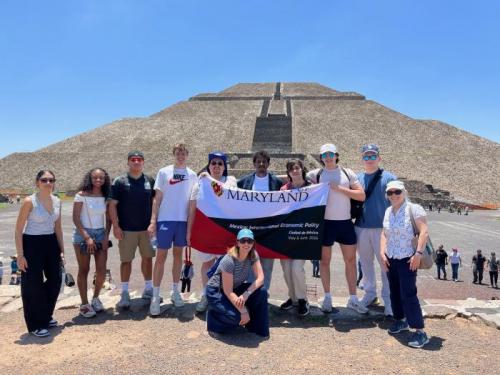
Nine University of Maryland undergraduate students recently returned from a two-week study abroad trip to Mexico City called “Mexico: International Economic Policy in Action.”
“I was very interested in this course because I had never been outside of the country before, and it was a study abroad opportunity that directly correlated to my major, which gave me credit for my major. This course also caught my attention because it was an ‘in action’ course, so I was excited to see what graduates with a major in economics do after college,” said Owen Hunting, a sophomore economics major.
By participating in the program, students like Owen earned three academic credits for the course “ECON358C: International Economic Policy.” Department of Economics faculty Dr. Martina Copelman and Dr. Stefania Scandizzo designed and organized the experience, which took place from May 28 to June 10.
“My main field is international trade, while Dr. Copelman’s main field is international macroeconomics, so we thought that this was a good convergence of our interests and of the type of courses we teach, which led us to design an international economic course abroad,” said Dr. Scandizzo, a principal lecturer. “When students take economics classes at Maryland, they are often looking at the problems from the point of view of the United States or how it affects the United States. So our idea with this course is to give students the content from the point of view of another country, to see the complexities of how economic policy is applied in different economic and cultural contexts.”
Helping students experience another culture was of both professional and personal importance to Dr. Scandizzo and Dr. Copelman, who each spent more than a decade living in other countries; Dr. Scandizzo lived in Venezuela for 10 years, and Dr. Copelman, who is originally from Argentina but raised in the United States, lived in Mexico City for 17 years.
“I think it’s important to open up students’ minds to the rest of the world,” said Dr. Copelman, who is also a principal lecturer. “I’m hoping students got a better sense of what global cooperation and global interaction looks like from a perspective that is more intimate and more real to them than just the conceptual models. And I also hope they loved the culture that they visited, because it is an amazing culture.”
Students were able to see how different areas of the economy and the government interacted and the role of public policy in designing the correct incentives. The group visited a variety of institutions over the course of the trip, and got to hear what experts had to say. Visits included the Ministry of Finance, the Mexican Stock Exchange, a microfinance bank called Gentera, and the largest commercial bank in Mexico, BBVA. Additionally, they were exposed to two different universities where they got lectures on Mexican history and its political system, as well as the effects of the United States-Mexico-Canada Agreement (USMCA) trade agreement on Mexico’s economy.
“The experience on the trip that was the most impactful to me was seeing how microcredit works in a country like Mexico,” said Gabrielle Redfearn, a junior economics major and international development and conflict management minor. “Being able to travel with Compartamos, a major financial institution in Mexico, around Mexico City as we saw how they go about checking in with their clients that they lend to allowed me to see the different livelihoods that reside within the same city. I believe that having that exposure was important and helped me receive a more comprehensive view of Mexico’s economy.”
That particular day of the trip stood out to junior economics and public policy double major Alex Gwiazda as well.
“Later in the day we visited Gentera Headquarters, which houses Compartamos Banco as a subsidiary. There, we learned about Social Enterprise and how for-profit corporations can be effective in solving social and economic issues,” recalled Gwiazda. “It was amazing to see how their organization was filling gaps that traditional government and non-profit organizations couldn't.”
The program also took students to two local universities—Instituto Tecnologico Autonomo de Mexico (ITAM) and Universidad Iberoamericana (IBERO), where they got to interact with peers.
Another fundamental element of the program was cultural immersion. The group visited multiple cultural sites, including the pyramids at Teotihuacan, Chapultepec Castle, the National Anthropology Museum, the floating gardens of Xochimilco, Frida Kahlo’s house and museum, and more.
“My favorite part of the trip was discussing the day’s events and experiences with students at the end of each day, and sharing insights, reflections and feedback,” said Dr. Scandizzo. “My favorite cultural visit was to the pyramids at Teotihuacan. I never thought I would be able to tell people I climbed a pyramid!”
Both Dr. Scandizzo and Dr. Copelman said the trip was a highlight of their decades-long teaching careers—and it seems it was a highlight of the students’ undergraduate careers too.
“I believe this study abroad trip gave me the confirmation that I needed to continue to study international economics,” said Redfearn. “Considering that I just completed my sophomore year, this trip helped me make complete sense of my goals and possibilities for my future through the experiences and knowledge that I gained on this trip.”
“As someone who has only been studying economics for a year, I have learned more over these two weeks than I think I ever could've just staying in College Park,” said Gwiazda. “I would absolutely recommend this for anybody remotely interested in economics, policy, or business. Professors Copelman and Scandizzo set up opportunities for us that we couldn't have gotten anywhere else.”
Dr. Scandizzo and Dr. Copelman plan to offer this Education Abroad course again in summer 2027.
This story was written by Rachael Graham and posted on the BSOS website. Read more here.